
Theme and Variation
Experiments with fictional form

Milan Kundera once described his novels as themes with variations.1 Such a pattern is easily discernable in Kundera’s works, which are structured around philosophical ideas that play themselves out in the lives of his characters, but arguably one can see any story in similar terms, though only to an extent. All stories have themes, after all, and these themes run throughout each in a variety of ways, often returning in modulated form. Nevertheless, such modulations are usually subtle and subordinated to narrative sequence. One can certainly read Dickens or Dostoevsky, for example, with particular attention to recurring motifs and symbols, and this can open exciting vistas of interpretation, but it would generally be a stretch to say that such elements are the foundation of the work itself.
There are notable exceptions to this, however, and many novelists have attempted to create forms that follow the theme-and-variation structure, frequently taking music for inspiration. As in music, the repetition of a theme provides new perspectives, either through the change of context or variations in the theme itself. Set against a new background, a theme can appear entirely different, transformed. With the imposition of slight variations, we begin to open the theme, to examine its possibilities, the plethora of meaning which it can evoke.
Kundera is explicit that his understanding of fiction is drawn from music, and the description I cited above occurs in the midst of musicological reflections. The themes he selects, and around which he circles, are by and large philosophical. in the Unbearable Lightness of Being, for instance, they are lightness and weight, which can be broadly understood to mean responsibility and attachment, on the one hand, and negative freedom, on the other.

A similar project is Andre Bely’s Symphonies, which uses repeating imagery to create a whirling phantasmagoria in which narrative is increasingly subordinated to an underlying structure of visual patterns. Describing his work, Bely states,
I must recommend that my Symphony be studied (first read it through, then examine the structure, then read it through again and again). But what right do I have for my work to be studied when I myself don’t know whether my whole Symphony is a paradox or not? Without careful attention to my literary devices, the Symphony seems dull, bloated, and written merely for the colorful tone of a few disparate scenes.
As Bely is clearly aware, The Symphonies is a frequently chaotic and confusing work, though one that is nevertheless fascinating and beautiful and that becomes more orderly the closer one attends to its musical structure.

Another book that comes to mind, though not one necessarily explicit in its relation to music, is The Blind Owl, by Sadegh Hedayat. The book tells the story of an opium addict who commits a murder, but it does so in two parts, both of which reflect and contradict one another and follow a dream-like logic. Images, events, and characters repeat and echo each other in each part, but are not identical in any straightforward way. The reader is unsettlingly present in the mind of the murderer, and whatever the “true” story is meant to be, it is scattered and twisted among the jumbled, chaotic motifs that never settle into anything recognizable as linear reality in any sane sense.
Beside their musical analogies, such works represent to my mind a method of fiction that flees realism, or even “objectivity” as such, for something more akin to experience as it exists on the margins of waking consciousness. These books follow logics more akin to dream, or to memory, which moves primarily via association rather than temporal sequence. This can be orderly, as with Kundera, or it can be chaotic, as with Hedayat or the more abstruse moments of Bely’s Symphonies. What is important in such instances is not sequence, but the inner relationships of those elements taken as the primary motifs, which can be rearranged, expanded, or altered in order to examine an idea or situation from many angles.
What one achieves with this is the impression of an underlying reality too large to be approached directly, the sense that some great or terrible truth is being uncovered piece by piece, some revelation just out of reach. With Kundera, this revelation would be an understanding of the philosophical questions his books pose. With Bely, it might be a sense of the relationship between time and eternity (he was deeply inspired by Russian Sophiology, after all, but I can’t say I’ve studied his text closely enough to grasp its full meaning). Hedayat is perhaps a more difficult case, as The Blind Owl is structured largely to produce disorientation. One is always attempting to arrive at the revelation, at the secret meaning, but never does. This is perhaps as good an analogue for insanity as any, for one is constantly linking elements of the text together, conspiratorially trying to resolve the contradictions and shifting perspectives, certain that something lies at the bottom, but doing so only contributes to the sense of disjunction.
In my own writing, I’ve tried experimenting with similar methods to examine certain kinds of situations. In the piece below, “Maple House,” which is more of a sketch than a story, really, that situation is a disintegrating romantic relationship. The characters are never named or fully described. Rather, a series of images layered atop one another and repeating in new contexts attempts to capture the underlying sense of that disintegration. This is done by viewing the house and its surrounding environment as caught up in the drama between the largely invisible characters, as reflections of their interior states. Nothing in the story is just a tree or a building. Everything is the relationship that is falling apart, and the motifs are presented in kaleidoscopic fashion as a means of circling around this central truth. I didn’t want the story to be obscure or esoteric, quite the opposite: I wanted to display the spiritual sense of the situation. If that sounds vague, it’s because I cannot say what it is I was attempting to capture. If I could, I would not have had recourse to the bizarre structure I employed, which, as with the works I described above, seeks to approach its subject obliquely. I think the piece mostly fails to be comprehensible, but I’m fond of it as an experiment nonetheless. You can read it below.
Maple House:
It was the maple that I noticed first when we came to live in the Marry Hills. It stood out beneath the mountain’s ribs, flecked in purple and burgundy, the long blackened line cracking along its trunk, extending nearly to its bent feet of roots. A thunderstorm, he said, and ran his hand, chapping in the evening frost, along the weeping tracery, up the corridors and the skirt boards of the house beside the gravel drive. We could see it twisted and burnt from the western sitting room and the circle of the breakfast table, down which ran a chipping gap.
The maple’s leaves were piled in the dirt, which smoldered. I could feel its breath-like heat, palpate the small mountains of ash collected round its trunk. Ash blew about the yard and lay in streaks of dirty snow upon the lawn or by the garden. It sat in cones along the creaking spines of fence.
The light in the morning dripped pink flames that shattered on the brickwork. The plumes of soft pink were suffused in the slitted gravel, the veins between the pavers, and were cut by half-lidded blinds and trickled in crimson pieces on the floor. We stepped across the broken, crimson plumes and walked in separate hallways, jolting crookedly away from one another’s paths. The traces that we carved piled conically at the foot of the stairs and blew against the walls in streaks. The woodwork moaned with the wind, and the red eaves of the house flaked or burned in slabs of broken light. The shadows in the slats were crooked feet.
The Marry Hills echoed our steps, and wisteria, swollen purple and dirty white, pushed beneath the lapped boards layering the house like leaves. I groaned in the frosted evenings underneath the quilts and reach of chapping hands. In the winter’s heaving lungs, the maple cracked, and I fell in the sleet when the light burst. I saw the lines between my bones in purple stacked along the chipping saddles of the ridge.
The grey carpet in the hallways stuck to our clothes, soiling the sheets. The purple traces in the quilts unstitched and scattered onto lifting floorboards. We lay in heaps of crimson and electric light and rolled ashes on the gaps and bulges of our spines. We smoldered in the morning, sitting in the cones beneath the cracking balusters, among the sleet-cut azimuths in jagged draws beneath the Marry Hills.
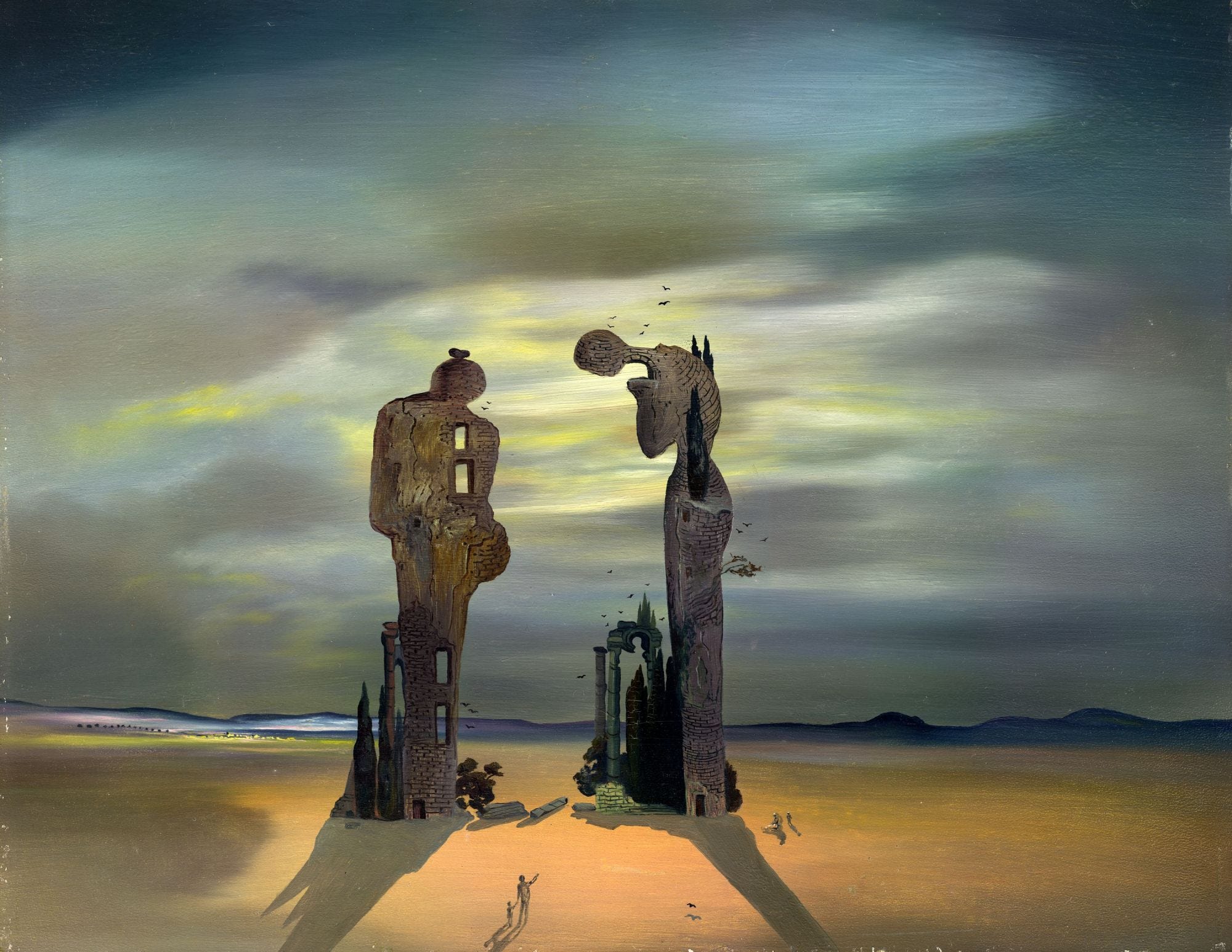
I think it was in Immortality, but don’t quote me on that.